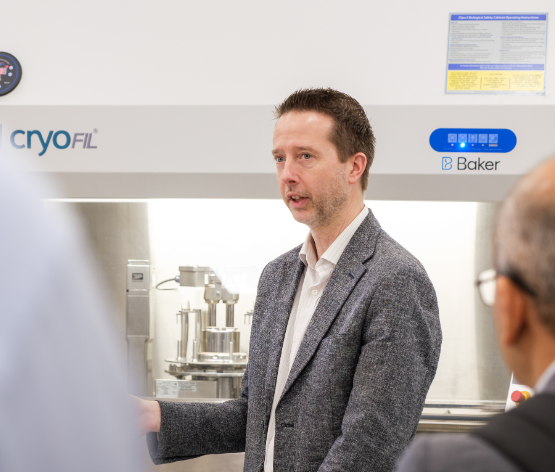
Driving Innovation in MedTech: An Interview with David Phasey
From home dialysis and hip replacements to rethinking one of medicine’s oldest devices, we’ve spent the last 20 years solving the engineering...
4 min read
Georgia Lewis-Marston
:
11 November 2026
From home dialysis and hip replacements to rethinking one of medicine’s oldest devices, we’ve spent the last 20 years solving the engineering challenges behind new technologies. For our latest conversation on innovation, I sat down with Innovation Director: David Phasey to talk about where his fascination with process engineering began, some of the more unusual challenges we’ve encountered and where he believes MedTech is heading next.
When we talk about innovation in MedTech, attention naturally falls on the device itself. The breakthrough idea, the technology that promises to make life better for patients. But behind every new medical device sits another challenge: how do we actually make this?
That’s a question we spend a lot of time answering at 3P innovation. David leads our Technology & Innovation initiatives, exploring emerging technologies and helping our customers bridge the gap between an exciting concept and something that can be manufactured reliably, repeatedly and at scale. And, as our conversation reveals, some of the most important innovation in MedTech happens in making that leap possible.
Could you tell me a little about your background in the sector?
"Whilst completing a placement year during my degree, I helped develop the manufacturing process and equipment for a new feminine hygiene product, which is still in production today. It gave me a real enthusiasm for using process engineering to enable new products. I later returned to work with the same group of talented engineers, now at 3P, to continue that journey. Since then, I’ve worked on a wide range of medical devices, from on-body patch pumps to auto-injectors, IUDs, and inhalers - many of which have been about targeting new patient populations or improving quality of life for recipients."
"The majority of our work is with smaller start-ups who have a novel medical device or technology and want to take it from prototype to commercial scale. For example, aVaxzipen, who are developing a new vaccine delivery system. We also often collaborate with specialist design consultancies who support larger companies. In those partnerships, they bring product expertise, and we bring manufacturing expertise. Our role usually starts right at the concept design stage, where product design and process development evolve together. That approach often unlocks benefits the client hadn’t even considered. From there, we take them through a phased journey, proving each step, eliminating risk and scaling up. By the end, they have manufacturing solutions that can range from small benchtop systems for clinical trials, all the way to high-speed production lines."
Hip Replacement: Zimmer Biomet
"With Zimmer Biomet, we developed an automated anodising system for their acetabular hip implants. What sounds simple is actually incredibly complex. We had to create a machine that could handle shell sizes from 42mm up to 80mm with no change parts, while guaranteeing absolute consistency in colour coding. That colour isn’t just aesthetic, it’s critical for surgical workflows and patient outcomes. Our engineers brought together expertise in electrochemistry and automation, precisely controlling voltage, current and workflow data to ensure every single implant met Zimmer’s standards. It’s a great example of where MedTech innovation is as much about process intelligence as product design."
Urinary Catheter Valve
"Catheters haven’t fundamentally changed since the 1930s, yet they remain one of the biggest causes of hospital-acquired infection. In this project, our engineers approached the problem differently and developed a novel catheter valve, inspired by the simple mechanics of a squeezy ketchup bottle. By restoring the bladder’s natural fill-and-empty cycle, it has the potential to halve infection rates and save the NHS millions each year.”
Dialysis Technology: Quanta Dialysis
"Dialysis is traditionally hospital-based, which is a huge burden for patients. Quanta Dialysis have developed a system that allows treatment at home, offering both cost savings and a much-improved patient experience. At the core of this innovation is a novel consumable that relies on moulded components and tubing sets, with a flexible film that pumps fluid. That film must be precisely cut and welded, and our automation ensured the process could be tightly controlled and scaled. By applying our expertise in fluid handling and precision engineering, we enabled Quanta to increase throughput, improve safety, and make home dialysis a practical reality for patients."
Intra-Uterine Device: Medicines360
“Every novel device often requires a unique automation solution. With Medicines360, for example, we supported the manufacture of an IUD, where the process involved feeding and knotting a long suture thread to very tight tolerances. In other projects, we’ve developed sealing and cutting methods for heat pouches in oncology therapy, moulding processes for patch pumps, and micro-assembly techniques for robotic surgical tooling. In each case, it’s the manufacturing process innovation that underpins the success of the medical product itself."
"One of the most exciting trends in MedTech right now is the introduction of a new dimension - time. Devices are no longer just designed for the moment of intervention, but to support the entire life span of the patient. That means accounting for how the body changes, how needs evolve, and creating technologies that remain effective over decades rather than months. Organisations like 4D Health Tech are leading the way here, addressing gaps in traditional device design by considering growth, movement and even tissue regeneration. It opens up the possibility of devices that don’t just treat a patient today, but actually evolve with them. Alongside this, there’s a clear shift toward diversity in patient needs. We’re learning more about how different populations respond to treatment, and there’s a growing recognition that devices must be designed with inclusivity at their core. The goal is to create solutions that serve the full breadth of patients, not just the majority.”
"Linked to these trends, one of the biggest challenges is how to diversify products and increase flexibility, while keeping costs down. Patients and providers want devices that adapt to different needs, which means manufacturers need much more flexible processes than they’ve ever had before. This is where 3P innovation is particularly strong. Our teams work across multiple sectors, combining different engineering disciplines and drawing on a very broad base of expertise. That allows us to help clients develop devices and processes that are versatile, scalable and cost-effective, without compromising on quality or compliance."
From home dialysis and hip replacements to rethinking one of medicine’s oldest devices, we’ve spent the last 20 years solving the engineering...

There are three main approaches to filling blisters with dry powder for inhalation: vacuum drum, membrane dosing and partial compaction and each has...
Around 1,000 people are diagnosed with cancer every day in the UK. Fortunately, outcomes continue to improve, with around half of those diagnosed...