Skip to the main content.

2 min read

Pouching solutions for sterile and moisture-sensitive devices

Pouches are widely used in medical device packaging to provide a sterile barrier when the device itself, or its primary container, cannot inherently maintain sterility. This is becoming increasingly important with the rise of non-traditional delivery systems and combination products.

Take, for example, a syringe designed to deliver a solid-dose injectable. Unlike a conventional liquid-filled glass syringe, it may not contain a stopper, which would normally form a critical sterile barrier. Without that stopper, an alternative enclosure is required to preserve sterility throughout storage, transport and handling. In many cases, that enclosure is a sterile pouch.

Sterile barrier pouches are typically manufactured from either foil laminates or Tyvek-based materials, each offering distinct advantages depending on the application.

Foil pouches provide a highly effective barrier against microorganisms, moisture and oxygen ingress, making them ideal for particularly sensitive products. They're often paired with desiccant sachets to maintain a low-humidity microenvironment within the package.

Tyvek pouches, on the other hand, offer excellent microbial barrier properties while remaining breathable. This makes them especially suitable for sterilisation methods such as ethylene oxide (EtO), where gas permeability is essential.

While both materials are widely used across the industry, integrating them into automated or aseptic manufacturing environments introduces a number of significant engineering challenges.

The challenges of sterile pouch handling

Unlike standard pouching operations used for loose or durable products, sterile applications demand far more specialised handling systems.

One of the primary challenges is that devices produced under aseptic conditions must be transferred and loaded into pouches within a Grade A (ISO 5) environment. This places strict requirements on equipment design. Systems must minimise particle generation, support sterilisation processes and ensure that non-sterile mechanical components remain segregated from the critical process zone.

The process becomes even more complex when products are highly sensitive to moisture. In these cases, vacuum pouching may be required to remove residual air and tightly control humidity levels inside the package. However, performing vacuum operations within a Grade A environment is far from straightforward. Conventional vacuum systems are not designed for sterile processing and can introduce contamination risks if not carefully engineered.

Geometry also presents a major challenge. Some devices, due to their size, fragility or unusual shape, are difficult to insert into pouches opened using traditional mechanical grippers. These systems often create narrow or poorly aligned openings, increasing the risk of insertion failures or product damage during handling.

Engineering solutions for aseptic pouching

To overcome these challenges, we have developed many tailored pouch-handling solutions using heated bar sealing technology.

While band sealers are commonly used in laboratory environments, they generate unacceptable levels of particulate contamination for sterile manufacturing applications and are therefore unsuitable for Grade A processing.

  • Solution 1: Semi-automated syringe pouching

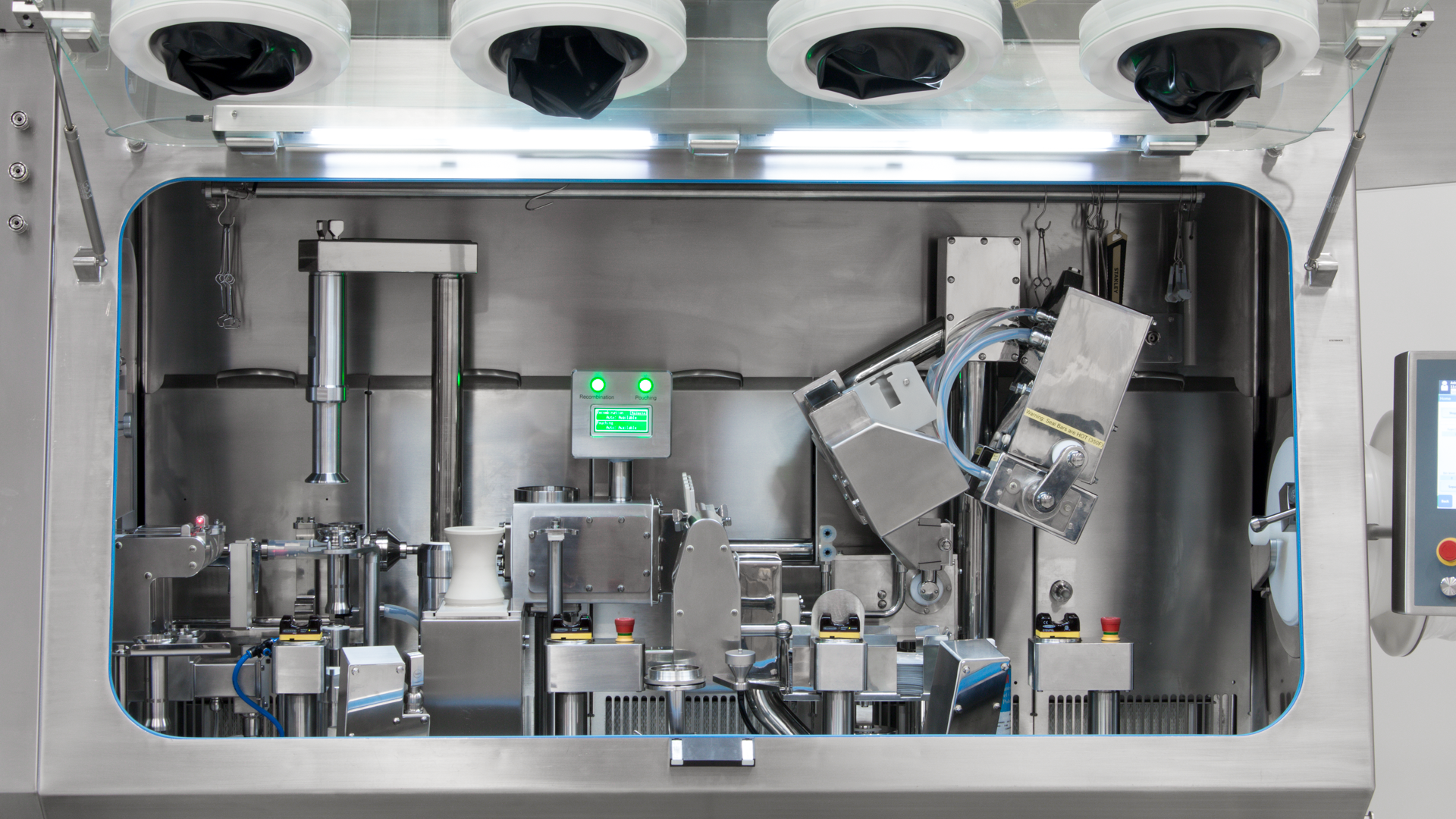
    In this system, pouches are automatically picked from a magazine and opened using vacuum cups before an operator manually inserts the syringe.

    To maintain aseptic integrity, all mechanical components and heating elements are isolated from the critical process area. The pouch is also held vertically throughout the operation, allowing first air to flow into and over the pouch opening, helping to protect the sterile pathway during loading.

  • Solution 2: Semi-automated vacuum pouching system

    For aseptic, moisture-sensitive devices, we developed a vacuum pouching system specifically designed for sterile environments.

    Unlike conventional vacuum sealers, the system incorporates removable, sterilisable gas pathways and sterile filtration to ensure that all air contacting the pouch remains sterile. The entire enclosure is also compatible with hydrogen peroxide (H₂O₂) decontamination, supporting integration into aseptic manufacturing facilities.

  • Solution 3: Fully automated pouch loading system

    By drawing air over the exterior surface, a pressure differential is created, causing the pouch to open into a more stable geometry that better accommodates automated device insertion. This significantly improves handling reliability for delicate or complex products.

More than just sealing a pouch

These examples demonstrate that sterile pouch loading and sealing is far more complex than a conventional packaging operation. When the pouch itself becomes the primary sterile barrier (and the product is filled aseptically) the packaging process must be engineered with the same level of care as the filling operation itself.

In many cases, this also requires a highly specialised approach to aseptic process simulation and validation, an area we will explore further in a future article.

Pouching solutions for sterile and moisture-sensitive devices

Pouching solutions for sterile and moisture-sensitive devices

Pouches are widely used in medical device packaging to provide a sterile barrier when the device itself, or its primary container, cannot inherently...

Read More
Interview with Founder Tom Bailey: Blister Dose Delivery Uniformity (DDU)

Interview with Founder Tom Bailey: Blister Dose Delivery Uniformity (DDU)

Dose Delivery Uniformity (DDU) is one of the most persistent challenges in dry-powder inhaler development, and few have tackled it more directly...

Read More
How our robotic isolator technology is setting a new standard for aseptic fill-finish

How our robotic isolator technology is setting a new standard for aseptic fill-finish

In the world of pharmaceutical manufacturing, our robotic isolator technology sets a new standard for aseptic fill-finish technology. By integrating...

Read More